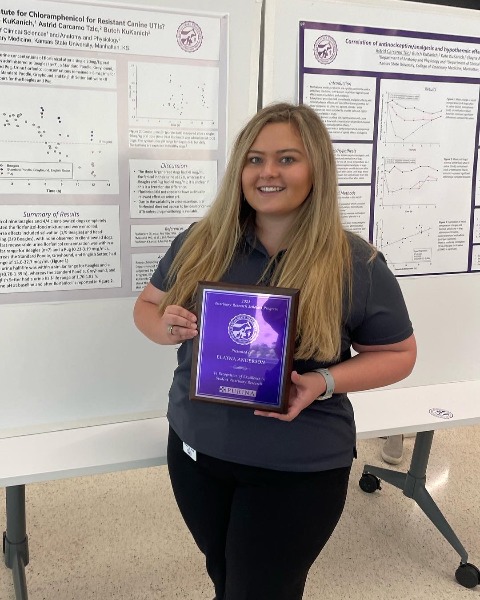
Veterinary Student Kansas State University College of Veterinary Medicine Manhattan, KS, United States
Abstract: Background- The ideal frequency of oral chloramphenicol administration for canine urinary tract infections is undetermined. Objective- To determine the canine urinary excretion protocol of chloramphenicol and optimize a dosing protocol.Animals- Seven healthy male intact purpose-bred Beagles and six healthy client-owned dogs of various breeds.Methods- Each dog received a single oral 50mg/kg dose of chloramphenicol. Urine was collected at baseline, 6, 8, 12, and 24 hours after drug administration. Results- At 8 hours, mean urine concentration of chloramphenicol from all dogs was 266.9 mcg/mL (90% CI 136.2-397.7 mcg/mL) but was lower in Beagles (mean 52.8 mcg/mL, 90% CI 8.5-97.0) than client-owned dogs. At 12 hours, mean urine concentration from all dogs was 110.5 mcg/mL (90% CI 36.4-184.7 mcg/mL) and again was lower in Beagles (mean 10.6 mcg/mL, 90% CI 1.4-19.8 mcg/mL) than client-owned dogs (mean 227.1 mcg/mL, 90% CI 101.1-353.1 mcg/mL). The urine half-life was similar for Beagles (1.84-3.84 h) as for client-owned dogs (1.78- 3.04 h). Conclusions and Clinical Importance- These findings justify the current common practice of dosing chloramphenicol 50mg/kg PO q 8 hours for canine UTI, rather than the labelled dose of q 6 hours. However, all client-owned dogs maintained therapeutic concentrations well above 8 mcg/mL, the wild-type cutoff target MIC for uropathogenic E. coli, for 12 hours, suggesting that q 12-hour dosing might be appropriate for non-Beagle dogs with susceptible lower urinary tract infections. A clinical trial in dogs with urinary tract infections is needed as well as further investigation into potential breed differences.